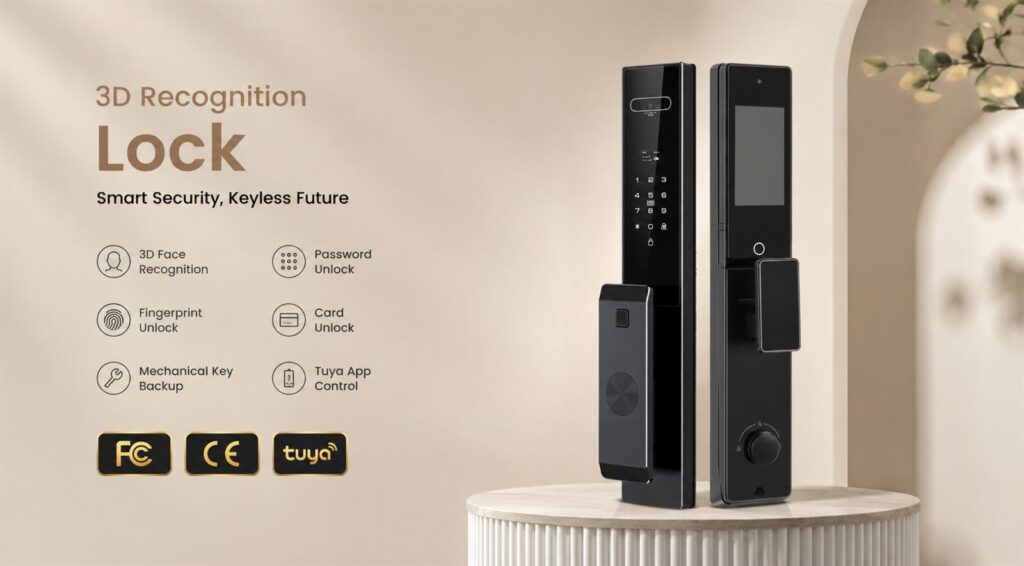
Ask someone what makes a face recognition lock secure, and you will usually hear about how fast or accurate it is. The better question is simpler and more important: can it tell the difference between your face and a picture of your face? That single distinction separates serious hardware from gimmicks, and it is the reason Decoresmart builds its flagship locks, like the DESF13, on 3D structured-light technology. Here is how it actually works, without the marketing fog.
The Problem with Cameras Alone
A standard camera captures a flat image: rows of pixels with color and brightness, but no sense of distance. To a flat image, your face and a life-sized printout of your face contain similar patterns of light and shadow arranged in similar positions. Software can look for hints of paper texture or screen moiré, and it sometimes catches them — but it is a guessing game against forgers who keep improving their prints, screens, and videos.
The core weakness is structural. If the sensor never measures depth, no amount of clever software can fully compensate for the missing dimension. That is why the category’s best-known failures — phones fooled by photographs, locks opened by tablet screens — all involve 2D sensing.
How Structured Light Adds the Third Dimension
A structured-light module projects a known pattern of infrared dots onto whatever stands in front of the lock — tens of thousands of them, invisible to the eye. A sensor positioned a small distance away then observes how that pattern lands. On a real face, the dots bend and shift across the curves of a nose, cheeks, and eye sockets. On a photograph, they land dead flat. On a curved mask, they distort in ways that reveal uniform material rather than living skin’s micro-movement.
From those observations, the module computes a depth map: a genuine three-dimensional measurement of the scene. Recognition then runs against that shape, along with infrared texture, rather than against a flat picture. Your enrolled template is a mathematical description of your face’s geometry — stored on the lock itself, not in a cloud.
Liveness: Catching the Spoofs
Depth alone would already defeat photographs and screens, which have no meaningful depth. But masks and 3D prints exist, so structured light works alongside active liveness checks:
- Micro-motion analysis — living faces make tiny involuntary movements; resin and silicone do not.
- Material reflectance — skin and screens scatter infrared light in measurably different ways.
- Depth variance mapping — a printed photo stuck to a stick has a planar depth signature the sensor flags instantly.
- Multi-frame capture — the module samples several frames in a fraction of a second, rejecting projections and replays that behave differently across frames.
In our internal test bank, the DESF13 rejects printed photos, phone and tablet video replays, standard resin masks, and 3D-printed face shells — while still recognizing the real owner in low light, with glasses, a hat, or a fresh beard.
Why It Also Unlocks Faster
Structured light is not just about security; it is about everyday behavior. Because the sensor actively illuminates the scene with its own infrared light, it does not care whether your porch is bright, dark, or backlit by a sunset. Recognition completes in a fraction of a second from a natural standing distance, with no phone in your hand and no code to remember — a difference you feel most when your arms are full of groceries.
Privacy Without Compromise
Biometric data deserves a conservative architecture. Enrollment and recognition run entirely on the lock’s processor. Face templates never leave the device, cannot be exported by the app, and are erased permanently when you reset the lock or delete a user. This aligns with the certified information security practices we maintain across the DEC platform, and it means a hacked cloud account has no faces to steal.
The Takeaway
When you evaluate any face recognition lock, ask two questions: does the sensor measure depth, and where do the templates live? If both answers are right, you are looking at hardware you can trust at your front door. If you would like to watch the DESF13 refuse a photograph in person, that demo runs daily at our booth appearances — and year-round for partners through the contact page.
A Note on Accuracy Numbers
Marketing sheets love giant numbers, so here is how to read ours honestly. Recognition performance is usually quoted as a false acceptance rate and a false rejection rate. For the DESF13, the structured-light system delivers a false acceptance rate on the order of one in a million against strangers, while the false rejection rate for the enrolled owner sits well under one percent in normal conditions. Those two numbers are enemies: loosen one and the other improves. What matters is where a vendor draws the line.
- We tune for security first: when conditions degrade, the lock asks you to try again rather than guessing generously.
- Failures fall back gracefully to fingerprint, code, or card — never to an unlocked door.
- Enrollment takes under a minute and stores a wider range of angles, which is what keeps real-world recognition high.
Anyone quoting a single accuracy figure without conditions is selling a number, not a lock.
For technically minded readers: the module also performs continuous self-checks, verifying projector alignment and sensor calibration at every wake event. If a unit ever drifts outside tolerance — from age, impact, or repair — it logs a maintenance code and requires service rather than silently degrading into a less picky lock. Failing loudly is a feature; failing quietly never is.
Back to all perspectives